Every student who walks through our doors for the first time brings the same question: "When will I start feeling different?" The honest answer - faster than you think, if you do one small thing consistently every morning.
What follows is the fifteen-minute sequence that our lead Hatha instructor, Meera Nair, has been teaching to beginners for eleven years. It is not ambitious. It is not impressive on the outside. It works precisely because of that.
Why the Morning Is Different
Your nervous system is most malleable in the first thirty minutes after waking. Cortisol - the hormone that governs alertness and stress response - naturally peaks at this time. What you expose your body to during that window sets a baseline tone that compounds throughout the day.
Research published in the International Journal of Yoga found that a brief morning movement practice reduced self-reported anxiety scores by 28% over eight weeks - without any other lifestyle changes. The mechanism is simple: controlled movement paired with deliberate breathing signals safety to the brainstem, which gradually recalibrates your default stress threshold downward.
"I don't teach people to be flexible. I teach people to be less braced against their own lives." - Meera Nair, Lead Hatha Instructor
The Fifteen-Minute Sequence
You need no mat, no props, and no previous experience. A clear patch of floor and your breath are the only requirements. Move through each position slowly - five to eight full breath cycles per shape unless stated otherwise.
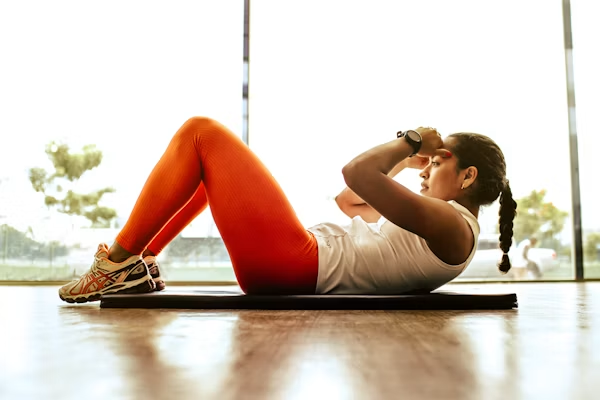
1. Supine Knees-to-Chest (2 minutes)
Lie on your back and draw both knees towards your chest. Rock gently side to side. This mobilises the lumbar spine and begins releasing the psoas - the hip flexor that tightens during sleep and holds stress from the previous day. Breathe into the lower back on the inhale; soften on the exhale.

2. Cat–Cow Flow (2 minutes)
Come to all fours, wrists under shoulders, knees under hips. On each inhale, drop the belly and lift the gaze (Cow). On each exhale, round the spine to the ceiling and draw the chin to the chest (Cat). Keep the movement breath-led rather than position-led - you are waking the nervous system, not stretching a muscle.
3. Downward-Facing Dog (90 seconds)
Press into the hands, lift the hips, and find length through the back. Pedal the heels alternately for the first few breaths, then settle into stillness. Notice where the body has held tension overnight - the hamstrings, the shoulders, the jaw. You are not trying to fix these things yet. You are only noticing.
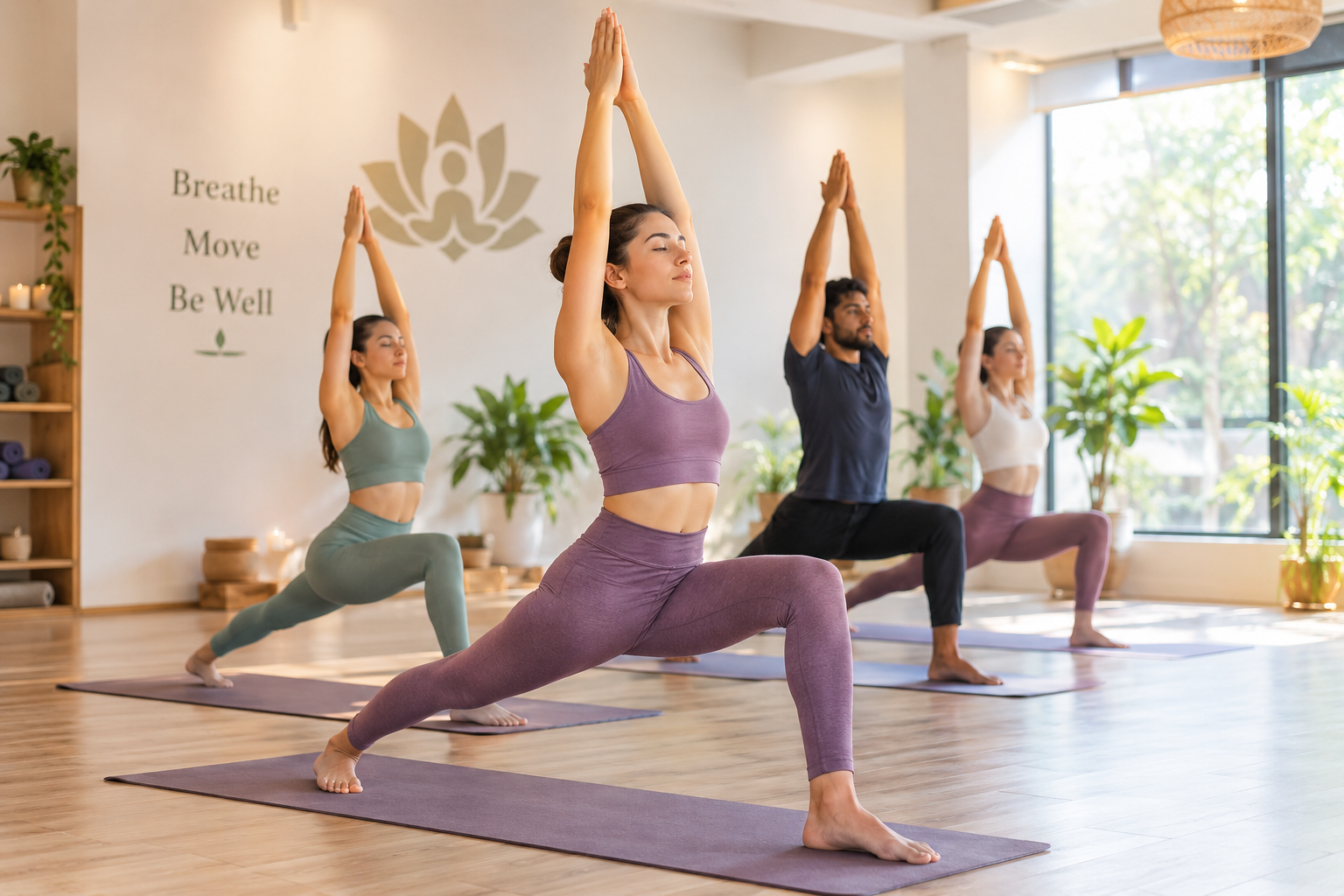
4. Low Lunge - Right then Left (2 minutes each side)
Step the right foot forward between the hands. Lower the left knee to the floor. Sink the hips forward and down until you feel the front of the left hip opening. Rest the hands on the right thigh. Stay here for eight full breaths before switching sides. This is where most students first notice they have been holding their breath. Let it go.
5. Seated Forward Fold (2 minutes)
Sit with legs extended. Hinge forward from the hips - not the waist - and rest the hands wherever they land, whether that is the shins, the ankles, or the floor. The depth of the fold matters far less than the evenness of the breath. Close your eyes. The body will release when it feels safe, not when it is pushed.
6. Reclined Spinal Twist - Right then Left (90 seconds each side)
Lie back down. Draw the right knee across the body to the left, and extend the right arm out to the side. Breathe into the space between the shoulder blades. This resets the thoracic spine and stimulates the vagus nerve - the primary pathway for the parasympathetic response. You will likely feel a noticeable softening in the chest.
7. Savasana with Breath Awareness (2 minutes)
Lie flat. Let the legs fall open. Let the arms rest away from the body. Breathe naturally but with full attention - notice the rise and fall of the chest, the slight pause at the top of each inhale, the complete release at the end of each exhale. This is the most important position in the sequence. Do not skip it.
What to Expect in the First Two Weeks
Most students notice one of two early responses. The first is a quiet sense of grounding that appears around day four or five - a feeling of arriving into the day rather than being pulled into it. The second is the opposite: initial restlessness, a reluctance to slow down, an almost physical resistance to the stillness. Both are signs the practice is working.
- Days 1–3: The body feels stiff; the mind wanders. This is normal. Return to the breath each time.
- Days 4–7: The sequence begins to feel familiar. Tension softens slightly faster than it did at first.
- Days 8–14: Mornings feel qualitatively different before you have even reached the mat. The anticipation of the practice is itself part of the reset.
- Beyond two weeks: The default stress threshold begins to shift. Students consistently report feeling less reactive during the remainder of the day - not because challenging things no longer happen, but because the gap between stimulus and response has widened.
The One Adjustment That Makes It Stick
The most common reason students abandon a morning practice is the same reason they abandon any habit: they try to do it perfectly. The sequence misses a day, or three, and the streak is broken, and then it feels like starting over, and the whole effort collapses.
Meera's advice - unchanged across eleven years of teaching beginners - is this: decide in advance what your minimum version looks like. For some students that is five minutes. For others it is a single Cat–Cow and one minute of Savasana. On a hard morning, do that. The chain of consistency is more valuable than the depth of any individual session.
"The practice is not the time on the mat. The practice is the decision to return." - Meera Nair
If you want to experience this sequence with guidance, Meera teaches Sunrise Hatha every Monday, Wednesday, and Friday at 7:00 AM. Your first class is free. Bring nothing - we have everything you need.


5 Comments
Join the conversation - your email won't be published.
I've been doing this sequence for three days and the difference is already noticeable. The low lunge especially - I had no idea how tight I was carrying my hips. Thank you Meera.
Priya, that is exactly what I hoped to hear. The hips carry so much of what we don't process during the day - keep going and let me know how week two feels.
Started attending Meera's 7AM class after reading this. The article is accurate - the pace is deliberately unhurried in a way that feels almost counterintuitive if you're used to faster classes. Highly recommend.
The quote about "the practice is the decision to return" is going on my mirror. I've been hard on myself every time I miss a day and this reframe genuinely helps.
Question - is this suitable for someone with a lower-back injury? I had a disc issue two years ago and I want to be careful with the forward fold in particular.
Leave a Comment
Your email address will not be published. Required fields are marked *